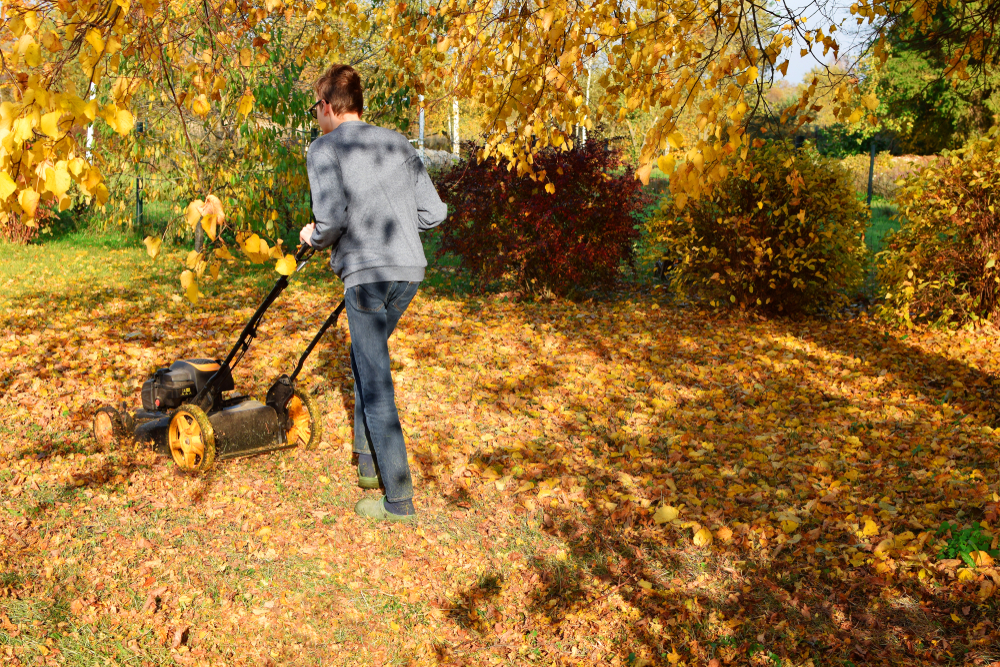
For years, the standard fall routine was simple: rake every leaf, stuff the pile into bags, and make the lawn look as though autumn never happened. Now gardeners are increasingly told to “leave the leaves,” which sounds wonderfully easy until a thick layer of wet maple leaves is plastered across the grass. The truth is that leaving fall leaves on the lawn can either help your yard or hurt it depending largely on how many leaves you have and what you do with them. University of Minnesota recommends mulching leaves into turf until you can still see about half of the lawn surface, then removing excess leaves for use elsewhere. Instead of choosing between obsessive raking and completely ignoring the yard, there’s a much easier middle ground.
A Light Covering of Leaves Can Stay
If only a scattering of leaves has landed on your grass, you don’t necessarily need to spend Saturday afternoon chasing every one with a rake. When only about 10% to 20% of a lawn is covered, leaves can generally remain without smothering the turf. Leaves naturally break down, returning organic material to the soil rather than requiring you to haul it away. They can also provide habitat for insects and other creatures that overwinter in leaf litter, an ecological benefit that disappears when every leaf is immediately shredded or removed. If leaving fall leaves on the lawn means a few scattered leaves with plenty of visible grass between them, doing less work may be perfectly reasonable.
A Thick Layer Is a Different Story
Problems begin when “leave the leaves” becomes a thick blanket covering most of the lawn. Heavy, matted leaves can suffocate turf, inhibit new growth in spring, and potentially contribute to problems involving pests and diseases such as snow mold. That makes sense when you consider what grass needs: even during fall, actively growing turf still needs access to sunlight, air, and moisture rather than being buried under a soggy mat. Leaves can become particularly troublesome after repeated rain presses them into a dense layer that’s much different from the loose leaves you saw falling from the tree. When you can barely see the grass anymore, leaving everything untouched isn’t doing the lawn a favor.
Your Lawn Mower Can Replace the Rake
Before buying leaf bags or spending hours hauling piles to the curb, try mowing the leaves instead. University of Minnesota recommends mulching dry leaves regularly and making a second pass when necessary to chop them finely enough to settle into the turf. As those pieces decompose, they return nitrogen, phosphorus, and potassium to the soil while adding organic matter that can improve soil structure, moisture retention, and water infiltration. Research summarized by Penn State also found no negative turf effects from properly mulching leaves into lawns and reported improvements including fewer broadleaf weeds. For a frugal gardener, turning something you already have into free organic material beats paying to remove it.
Use the 50% Rule When You’re Unsure
You don’t need a soil test or complicated formula to decide when your lawn has reached its leaf limit. University of Minnesota offers an unusually practical benchmark: mulch leaves until only about 50% of the lawn surface remains visible, then start moving excess leaves elsewhere. That isn’t a magic biological cutoff that means 49% visible grass is safe and 51% is doomed, but it provides homeowners with an easy visual guide. If repeated mowing still leaves the turf buried, you’ve reached the point where the quantity of leaves exceeds what should remain on that particular patch of lawn. This makes leaving fall leaves on the lawn less of a philosophical debate and more of a simple question: can you still clearly see the grass?
Move Extra Leaves Into Garden Beds
Leaves that don’t belong on the lawn don’t have to go into a trash bag. Penn State recommends using shredded leaves as mulch around trees and shrubs and in perennial beds, where approximately two to four inches can help moderate soil temperature, conserve moisture, suppress weeds, and eventually add organic matter. Shredding helps because smaller pieces break down faster and are less likely to form the dense mats that whole leaves sometimes create. You can also move some whole leaves into appropriate garden beds or less manicured areas where they can provide overwintering habitat. You’re essentially transferring a free resource from a place where too much can cause problems to a place where it can save you money on purchased mulch.
The Compost Pile Can Take the Rest
If your property has several mature trees, you may produce more leaves than the lawn and garden beds can reasonably absorb. That’s when the compost pile becomes particularly useful because dry fallen leaves provide the carbon-rich “brown” material needed to balance nitrogen-rich materials such as fresh grass and kitchen scraps. It is recommended that you shred leaves to increase their surface area and speed decomposition, although whole leaves will eventually break down too. Another low-effort option is leaf mold, made by simply allowing collected leaves to decompose separately over time. Either approach turns excess leaves into a future soil amendment instead of something you pay to have hauled away.
Don’t Send Leaves Into the Street
Moving leaves off the lawn shouldn’t mean blowing them into the road or storm drain. Leaves that wash into stormwater systems and waterways contribute organic matter and nutrients, including phosphorus, that can degrade water quality and encourage excessive algae growth. Instead, keep them on your property when practical by mulching, composting, or moving them into suitable planting areas. If you truly have more leaves than you can use, follow your municipality’s rules for leaf collection or yard-waste disposal rather than treating the street as an extension of the lawn. Leaving fall leaves on the lawn may be optional, but keeping yard debris out of storm drains is an important part of responsible fall cleanup.
Diseased Leaves Deserve a Separate Decision
Not every fallen leaf belongs in your carefully cultivated compost or garden mulch. Try to separate diseased leaves from material you plan to recycle or compost because some plant pathogens can survive in infected debris. If a tree has been dealing with a significant fungal or other disease problem, identify the disease and check recommendations from your local Cooperative service before redistributing those leaves around the landscape. That doesn’t mean one spotted leaf requires hauling the entire yard to the landfill, but it does mean gardeners shouldn’t blindly assume every piece of plant material should be reused everywhere. Selective cleanup is often smarter than either extreme of removing absolutely everything or leaving absolutely everything.
The Best Fall Lawn May Look a Little Messier
A healthy lawn doesn’t have to look vacuumed every day from October through December. A modest amount of leaf litter can remain, and chopped leaves can return nutrients and organic matter to the soil while saving you the time and expense of bagging everything. The point where that changes is when leaves become thick enough to mat down, cover most of the grass, and interfere with healthy turf. Mow manageable amounts, relocate the excess to garden beds or compost, and leave some intact leaves in appropriate areas for overwintering wildlife.
When it comes to leaving fall leaves on the lawn, are you a rake-everything gardener, a leave-it-all gardener, or somewhere in the middle?
What to Read Next
Before You Bag Your Fall Leaves, Try These 5 Free Uses for Them
What Happens If You Never Rake the Leaves in Your Yard?
Powdery Mildew Is Everywhere This Fall — Can Those Leaves Go in Compost?
Leave a Reply