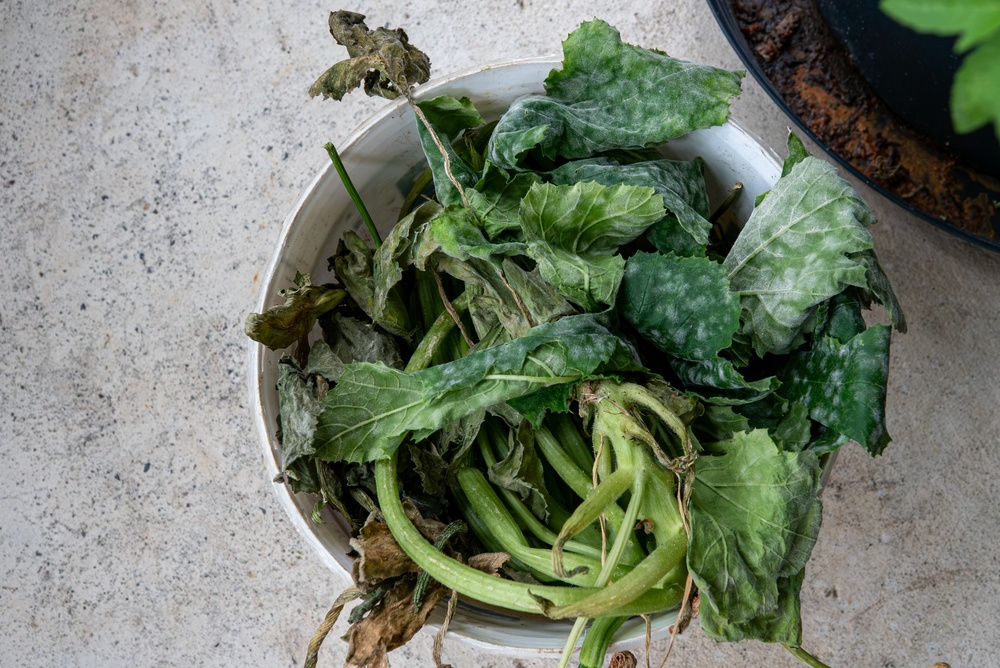
By late summer and early fall, a perfectly healthy-looking squash, cucumber, bee balm, or zinnia can suddenly look like someone dusted its leaves with flour. Powdery mildew is extremely common, and once cold weather approaches, gardeners face a practical question: what should happen to all those infected leaves and vines? Tossing them seems wasteful when you’re trying to build free compost, but adding disease back into the garden doesn’t sound particularly appealing either. Unfortunately, whether you should compost powdery mildew leaves isn’t quite as straightforward as many gardening tips make it sound. University extension experts offer different recommendations, and understanding why can help you decide what makes sense for your compost pile.
First, Make Sure It Really Is Powdery Mildew
Powdery mildew usually appears as white or gray powdery growth on leaves, although stems and other plant tissue can also become infected. The University of Minnesota explains that the disease isn’t caused by one universal fungus but by several related fungi that infect different plants. On cucurbits such as pumpkins, squash, melons, and cucumbers, powdery mildew commonly appears in mid- to late summer and can spread rapidly under favorable conditions. Severely affected leaves may eventually yellow and die, while heavily infected vegetable plants can produce fewer or smaller fruits. Correct identification matters before deciding whether diseased plant material belongs in your compost.
Powdery Mildew Can Survive From One Season to Another
One reason gardeners worry about infected leaves is that some powdery mildew fungi have ways of surviving winter. Utah State University explains that some overwinter on plant debris in specialized survival structures or persist as fungal growth on living plant tissue. Those structures can release spores when conditions become favorable again the following season. Powdery mildew spores can then spread through wind and other mechanisms to susceptible plant tissue, depending on the particular fungus involved. That’s why leaving a thick layer of heavily diseased plant debris sitting around susceptible plants isn’t the best end-of-season cleanup strategy.
Some Experts Say You Can Compost It
Here’s where the advice gets complicated. An answer from a plant pathologist says composting plants affected by powdery mildew should not be a problem, explaining that the composting process kills the fungus along with the plant material. More broadly, diseased plant material can be composted when a pile reaches at least 148 degrees Fahrenheit, and the material completely breaks down. A properly managed hot pile therefore isn’t the same environment as a heap of leaves slowly decomposing behind the shed. If you compost powdery mildew leaves under genuinely hot, well-managed conditions, there is credible extension guidance supporting the practice.
Other Experts Say Home Gardeners Shouldn’t Risk It
The catch is that many backyard compost piles don’t reach or maintain temperatures capable of reliably sanitizing diseased material. Home gardeners shouldn’t compost diseased plant material because most home compost systems don’t become hot enough to kill spores. It is also recommended that you remove and destroy powdery-mildew-infected plant material instead of putting it into a compost pile. Even Oregon State’s more recent powdery mildew management guidance recommends bagging and discarding infected plant material rather than putting it in home compost. For gardeners with a passive pile that rarely gets noticeably hot, taking the conservative approach is reasonable.
Know Whether You Have a Hot Pile or Just a Decomposition Pile
Many gardeners describe anything containing kitchen scraps and leaves as “compost,” but the conditions inside those piles can be dramatically different. A properly managed hot compost pile needs an appropriate balance of carbon-rich and nitrogen-rich material, moisture, oxygen, sufficient volume, and regular management to generate and maintain substantial heat. A small pile that receives occasional banana peels, grass clippings, and autumn leaves may produce excellent compost eventually, but it may never achieve pathogen-killing temperatures throughout the entire pile. Using a long compost thermometer is much more informative than guessing based on whether the center feels warm when you turn it. If you can’t verify that your system gets hot enough, don’t assume it will safely compost powdery mildew leaves simply because the material eventually disappears.
You Don’t Need to Throw Away Every Leaf in the Yard
Powdery mildew on one crop doesn’t mean every piece of autumn garden debris is contaminated and destined for the trash. Healthy leaves, untreated plant trimmings, spent annuals without signs of disease, and other suitable organic material can still become valuable homemade compost. Separate obviously diseased vines and foliage as you clean beds rather than mixing everything together first and trying to sort it afterward. Also clean gardening tools after working with infected plants and remove heavily infected debris from around susceptible plants before the next growing season. That lets you protect next year’s garden without sacrificing an entire season’s worth of perfectly useful compost ingredients.
Prevention Next Year Starts With This Fall’s Cleanup
Removing diseased foliage is only one part of reducing future powdery mildew problems. Resistant varieties, along with adequate spacing, staking, and weed control, can help improve air movement around susceptible plants. Dense plantings and shaded areas can create conditions that make powdery mildew problems worse, so giving sprawling vegetables more room can help. You should remove the infected plant material after harvest and improve airflow through proper spacing. In other words, deciding whether to compost powdery mildew leaves matters, but next year’s plant selection and garden layout may matter even more.
When in Doubt, Keep Diseased Leaves Out
If you’re running a carefully managed hot compost pile and monitoring its temperature, credible extension guidance supports composting some diseased plant material under the right conditions. If your “compost pile” is mostly a slow-moving heap that sits through winter, however, discarding heavily infected powdery mildew material is the more cautious choice. That doesn’t mean you’ve failed at frugal gardening; protecting next year’s plants can be worth more than the small amount of compost those vines would have produced. Keep composting your healthy garden debris, clean up infected material, and make notes about which varieties struggled so you can choose more resistant options next season.
Do you compost powdery mildew leaves, throw them away, or maintain a hot pile specifically so you can compost diseased garden debris? Share your method in the comments.
What to Read Next
7 Garden Problems You Don’t Want Surviving in Next Year’s Compost
Don’t Compost These 7 Plants When You Clean Out the Garden This Fall
Should You Compost Diseased Plants? The Answer Depends on How Hot Your Pile Gets
Leave a Reply