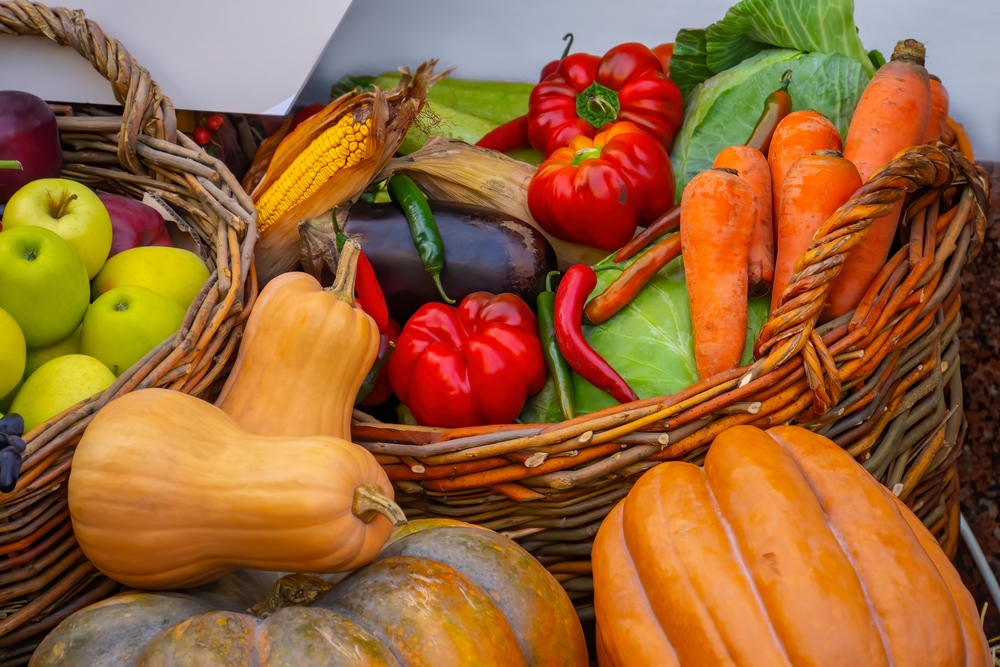
Spending $25 at the grocery store doesn’t buy much produce anymore, but could the same $25 planted in the backyard turn into $100 worth of vegetables? It’s possible, although the viral-sounding four-times-your-money return requires something many garden-budget calculations conveniently ignore: you need to already have a little infrastructure. If you own basic tools, have usable garden soil or containers, and can supply water without buying expensive equipment, a carefully planned $25 fall garden has surprisingly good economics. The trick is choosing crops that are inexpensive to start, mature quickly, and provide a relatively expensive product at the grocery store. Let’s put an actual shopping list and harvest target behind the claim instead of pretending every packet of seeds magically becomes $100.
Start With Seeds, Not a Cart Full of Transplants
The fastest way to destroy a $25 fall garden budget is filling your cart with individual vegetable transplants, decorative containers, bagged soil, fertilizer, and gardening gadgets. Iowa State University notes that vegetable gardening can save money, but equipment, fertilizer, pesticides, water, and other inputs can make even a small garden surprisingly expensive. For our experiment, let’s assume you already have a roughly 4-by-8-foot patch of workable soil, basic hand tools, and access to water. Spend about $15 on five seed packets—spinach, leaf lettuce, radishes, turnips, and carrots—then reserve roughly $10 for compost, fertilizer, mulch, or another input your particular garden needs. Seed packets vary considerably in price, so gardeners who already have leftover seed or homemade compost could bring the starting cost even lower.
Choose Crops That Actually Like Fall
Trying to squeeze another tomato or cucumber crop into cool weather isn’t the smartest way to make this experiment work. NC State identifies carrots, lettuce, radishes, spinach, turnips, kale, collards, beets, broccoli, cabbage, and several other vegetables as cool-season annuals that thrive when temperatures are below 70°F. Those crops give a $25 fall garden another advantage: several can be direct-sown, eliminating the expense of purchasing established plants. Location still matters tremendously because a September planting that works in one region may be weeks too late somewhere with an early freeze. Work backward from your expected first frost and compare the seed packet’s days-to-maturity figure before spending anything.
Greens Give the Budget Its Best Chance
If maximizing grocery value is the goal, I’d devote a large portion of the bed to spinach and leaf lettuce rather than inexpensive storage vegetables. Harvest lettuce and spinach as “cut and come again” crops, cutting plants carefully while leaving the growing point intact. The Extension guidance says these plants can resprout and potentially be harvested three or four times this way. That repeat production changes the economics because one planting can generate several salads instead of one harvest. If eight harvests across your lettuce and spinach sections average even $5 worth of comparable store-bought greens each, you’ve generated roughly $40 of our hypothetical $100 target.
Radishes Can Produce Value Fast
Radishes aren’t glamorous, but they’re almost tailor-made for a cheap fall garden because they’re quick and don’t require purchased transplants. Radishes are among the short-season hardy crops that can be planted during September in parts of North Carolina. A packet containing dozens or hundreds of seeds can therefore produce multiple rows, depending on variety, spacing, germination, weather, and available growing time. Suppose your $25 fall garden produces four decent bunches comparable to $2 grocery-store bunches; that’s another $8 of food. Successive sowings spaced a week or two apart can also prevent 40 radishes from becoming ready on the same Tuesday.
Carrots and Turnips Fill Out the Harvest
Next, give carrots and turnips enough room to produce a meaningful root crop while remembering that the leaves of turnips can also be food. NC State’s vegetable gardening handbook includes carrots and turnips among vegetables suitable for fall gardens and notes that cool-season vegetables produce well during cooler fall conditions. Imagine harvesting 10 pounds combined and valuing them conservatively at an average of $2 per pound compared with what similar produce would have cost locally. That’s approximately $20 worth of food, bringing our running hypothetical total to $68. Add usable turnip greens, additional carrots, or another succession of quick radishes and the grocery replacement value keeps climbing without another major investment.
6Here’s What the $100 Target Actually Requires
Now let’s run a reasonable target rather than pretending we know exactly what your soil will produce: $40 of lettuce and spinach, $8 of radishes, $20 of carrots and turnips, and roughly $32 from additional greens, second sowings, turnip tops, or another productive cool-season crop. That gets the theoretical retail replacement value to $100 from a $25 investment, producing $75 more food value than the cash spent. Importantly, that’s not $75 of profit, because your time has value and we haven’t assigned a dollar amount to water, existing tools, land, or previous soil improvements. Current vegetable price information also changes over time and by location, which is why the USDA Economic Research Service maintains regularly updated vegetable retail-price data rather than one universal grocery price. Think of $100 as the stretch goal for a productive $25 fall garden, not a guaranteed return printed on the back of a seed packet.
One Failed Crop Can Change the Math Quickly
Gardening spreadsheets have one major weakness: plants don’t read spreadsheets. Poor germination, unusually hot September weather, an early hard freeze, rabbits, insects, drought, or excessive rain could easily turn our projected $100 harvest into $60—or $20. Lettuce and spinach can have trouble germinating when soil temperatures exceed 85°F, which demonstrates why planting at the right time matters. Seeds also need consistent moisture during establishment, and wasting an entire packet because the seedbed dried out is an expensive mistake on a $25 budget. The most financially successful gardener isn’t necessarily the person planting the most vegetables; it’s often the person paying close enough attention to keep the inexpensive ones alive.
Succession Planting Makes $25 Work Harder
You don’t necessarily need another packet of seeds to get another harvest—you may simply need to stop planting the whole packet at once. Quick-growing crops such as radishes, lettuce, spinach, turnips, and other greens as strong fall choices. Planting smaller amounts at intervals can keep produce coming instead of creating one enormous harvest that your household can’t eat before it spoils. That matters financially because a $4 bag’s worth of homegrown lettuce only saves $4 if someone actually eats it. A $25 fall garden should therefore be designed around what your household buys and consumes, not around producing the largest possible pile of vegetables.
The Cheapest Vegetable Is the One You Actually Eat
Yes, a $25 fall garden can plausibly produce $100 worth of food under good conditions, particularly if you already own the tools, have established soil, grow from seed, and concentrate on high-value greens and repeat harvests. It can just as easily fail to hit that target if you need to buy containers and soil from scratch or lose half the crop to weather and pests. Keep your first investment small, track exactly what you spend, weigh or count what you harvest, and compare it with the price you’d actually pay for equivalent produce at your regular grocery store. That experiment will tell you more about the financial value of your garden than any blanket claim that growing vegetables always saves money.
Would you try a $25 fall-garden challenge, and which vegetables would you plant to get the most food for your money? Share your strategy in the comments.
What to Read Next
Powdery Mildew Is Everywhere This Fall — Can Those Leaves Go in Compost?
Garlic Goes in the Ground This Fall, But Timing It Wrong Can Ruin Next Year’s Harvest
Those Tiny Holes in Your Fall Vegetables Are Trying to Tell You Something
Leave a Reply