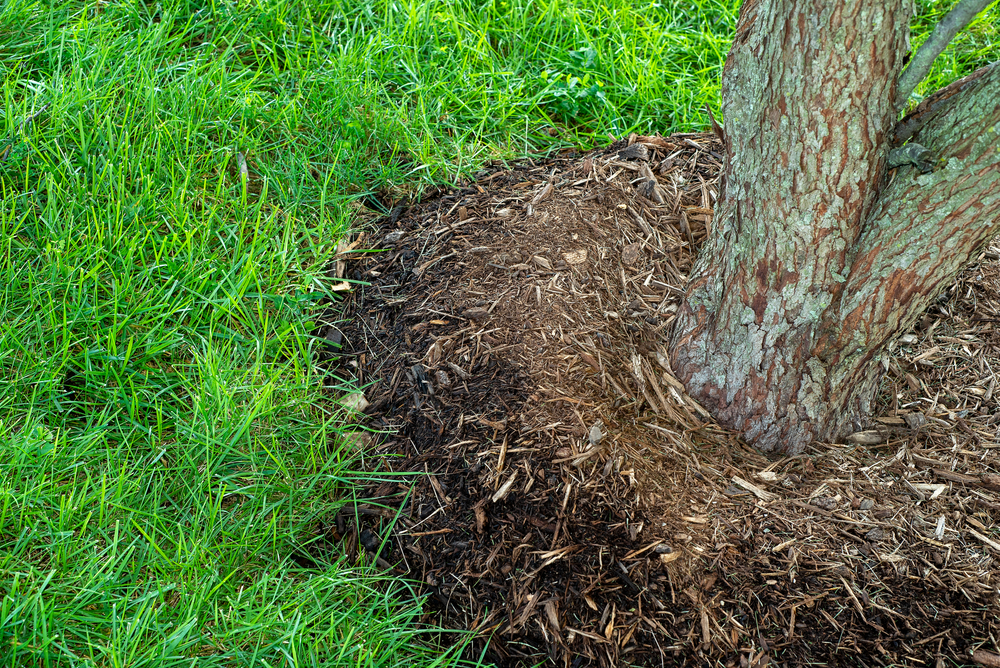
That perfectly shaped mountain of mulch around your tree might make the yard look professionally landscaped, but it could be doing more harm than good. Mulch is genuinely beneficial when used correctly because it conserves soil moisture, moderates temperature, suppresses weeds, and protects trees from lawn equipment. The problem starts when homeowners keep adding fresh mulch without checking how much is already there or pile it directly against the trunk. Over time, too much mulch around trees can contribute to problems involving roots, moisture, oxygen, bark decay, and even pests. Before buying another bag this fall, walk outside and check whether your trees have a flat mulch ring—or a mulch volcano.
The Mulch Volcano Is the First Warning Sign
You’ve probably seen mulch piled into a steep cone around a tree trunk in yards, parking lots, and professionally maintained landscapes. It may look tidy, but Penn State warns that mulch should be spread outward rather than upward and should never be piled against the trunk. A properly mulched tree should have a visible root flare, which is the widening area where the trunk transitions into the root system. If the trunk appears to disappear straight into a mound of mulch like a telephone pole, pull the material back and see whether you can locate that flare. Spotting too much mulch around trees early can give you an opportunity to correct the problem before years of improper mulching create more serious issues.
Deep Mulch Can Interfere With the Roots Below
Tree roots need more than water and fertilizer because they also depend on oxygen in the soil. University of Minnesota warns that excessively deep mulch can reduce oxygen levels around roots and contribute to root suffocation. Surprisingly, a very thick mulch layer can also interfere with rain or irrigation reaching the root zone, meaning a tree surrounded by what looks like moisture-conserving mulch could still experience dry roots. Poorly drained soil creates the opposite problem because deep mulch may keep the root zone excessively wet and encourage root rot. Too much mulch around trees can therefore interfere with the balance of air and moisture that healthy roots need rather than simply providing extra protection.
Wet Mulch Against the Trunk Can Damage Bark
Tree trunks aren’t supposed to remain buried in a moist layer of decomposing organic material. University of Maryland explains that bark kept moist around a buried root flare can create opportunities for wood-damaging insects or diseases to enter. The problem can be particularly easy to miss because the affected portion of the trunk is hidden beneath mulch while the canopy may continue looking relatively normal for some time. Penn State also warns that excessive mulch can create favorable hiding places for mice, voles, and other rodents capable of damaging bark. Keeping mulch away from the trunk isn’t merely an aesthetic preference—it’s an important part of protecting the tree itself.
Girdling Roots Can Become a Slow-Moving Problem
One of the more serious consequences associated with improper planting and mulching can develop largely out of sight. Deep mulch may encourage roots to grow into the mulch layer, and those roots can eventually circle around the trunk or other roots instead of extending normally into surrounding soil. Stem-girdling roots are a slow threat that can constrict the movement of water and nutrients as both the roots and tree trunk enlarge. A tree may survive for years while gradually losing vigor, making it difficult for a homeowner to connect the decline with the way the tree was mulched long ago. Preventing too much mulch around trees is much easier and cheaper than trying to correct serious root problems after they become established.
Two to Four Inches Is Usually Plenty
You don’t need a towering mound to get the benefits that make mulch valuable in the first place. Try generally applying about two to four inches of organic mulch, using less in poorly drained soil and only one to two inches for finely textured or double-shredded material. You can also have a more conservative approach, applying a shallow layer of roughly one to three inches while keeping mulch away from the trunk. The precise recommendation can vary somewhat with mulch texture, soil drainage, and site conditions, but none of these recommendations call for a foot-high volcano surrounding the tree. When you’re unsure, think wide and shallow rather than narrow and deep.
Pull the Mulch Away From the Trunk
Correcting a basic mulch volcano may be simpler than homeowners expect. Penn State recommends carefully pulling excess material away from the trunk until the root flare becomes visible, with roughly three to five inches of clearance suggested for young trees and eight to 10 inches for mature trees. Instead of throwing that mulch away, spread it farther across the tree’s root zone while keeping the overall layer within the recommended depth. Extending mulch outward toward the drip line can suppress grass competition, conserve moisture, and reduce the chance that a mower or string trimmer damages the trunk. In other words, correcting too much mulch around trees may require rearranging the mulch you’ve already purchased rather than spending another dollar.
Don’t Automatically Add Fresh Mulch Every Year
One reason mulch volcanoes become so large is the annual landscaping ritual of adding another layer simply because the old mulch has faded. Check existing mulch before adding more. The total depth shouldn’t be allowed to exceed about three inches under its guidance. Organic mulch decomposes over time, but that doesn’t mean every tree needs several new bags piled around it every spring or fall. Sometimes lightly raking existing mulch to break up compacted material and improve its appearance is all that’s necessary. Skipping unnecessary mulch purchases can save money while preventing too much mulch around trees, making this one of those unusual gardening situations where buying less may actually be better for the landscape.
A Buried Root Flare May Signal a Bigger Problem
There’s one situation where simply pulling back the mulch may not completely solve what you find. If you remove the mulch and still can’t locate the root flare, the tree may have been planted too deeply or excess soil may be covering the trunk base. Deeply planted trees may lack vigor, and that root-collar excavation can sometimes be used to expose a buried flare. For a valuable mature tree, major excavation around the root collar is a good reason to consult a certified arborist rather than aggressively digging around important roots yourself. The goal is to correct a simple mulching mistake without accidentally turning it into root damage.
Your Trees Need a Donut, Not a Volcano
Proper mulching isn’t complicated: keep the layer reasonably shallow, spread it broadly over the root zone, and leave the trunk and root flare exposed. Mulch still delivers plenty of benefits when applied correctly, including moisture conservation, weed suppression, temperature moderation, and protection from lawn equipment. Before adding new material, push a finger, ruler, or small trowel through what’s already there and check the actual depth because several years of accumulated mulch can be surprisingly thick. If you discover too much mulch around trees, redistribute the excess instead of automatically hauling it away, and you may improve your tree’s growing conditions without spending anything.
Have you checked the mulch around your trees lately, and were you surprised by how deep it actually was? Share what you found in the comments.
What to Read Next
Planting a Tree This Fall? This $0 Mistake Can Kill a $100 Tree
Leave a Reply