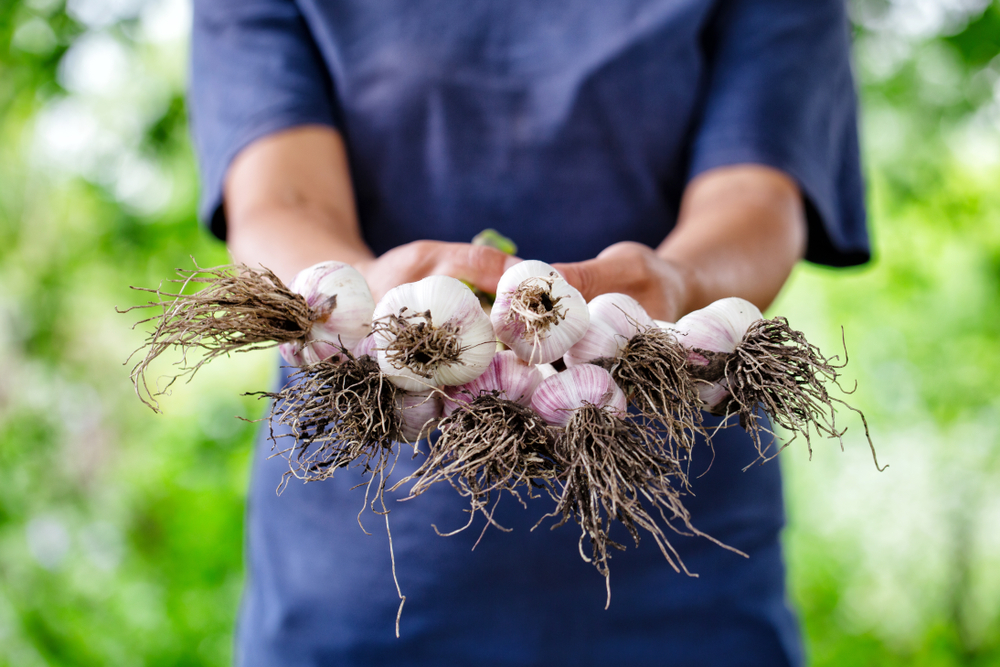
Garlic seems like the perfect frugal garden crop: bury a clove, wait several months, and pull up an entirely new bulb. But when grocery-store garlic is relatively inexpensive, does growing garlic actually save enough money to justify giving it garden space? The answer depends heavily on what you pay for planting stock, how many bulbs you harvest, and whether you save some of that harvest to plant again. Garlic has an advantage over many garden crops because you don’t necessarily need to buy new planting material every season. Run the numbers over several years rather than one harvest, and the economics of growing garlic become much more interesting.
One Garlic Clove Can Become an Entire Bulb
The basic math behind growing garlic is surprisingly appealing because you’re multiplying what you plant rather than simply harvesting the original clove. According to N.C. Cooperative’s 2026 garlic-growing guidance, a typical grocery-store head may contain roughly 10 to 20 individual cloves, and each planted clove can develop into a new head. That means planting 30 viable cloves could potentially produce about 30 bulbs if conditions and survival cooperate. Garlic generally wants full sun and well-drained soil, and spacing requirements aren’t enormous, making a modest crop practical even in a relatively small garden bed. Unlike tomatoes or squash, you’re also harvesting something that can potentially remain usable long after the growing season ends.
Seed Garlic Makes the First Year More Expensive
The catch is that gardeners shouldn’t calculate their savings by assuming a 99-cent grocery-store bulb automatically becomes 10 free plants. The University of Maryland recommends certified, disease-free planting garlic and warns that supermarket garlic can carry disease without showing obvious symptoms. Iowa State University similarly advises against supermarket cloves because varieties may not suit the local climate and storage practices can interfere with successful bulb development. Quality seed garlic can cost considerably more than ordinary cooking garlic, so your first crop may not beat the supermarket financially. Think of the initial purchase as startup capital rather than expecting growing garlic to deliver maximum savings immediately.
Let’s Run a $25 Backyard Garlic Example
Suppose a gardener spends $20 on seed garlic and another $5 on miscellaneous soil amendments or fertilizer, for a $25 first-year investment. If that provides 30 good planting cloves and 27 successfully reach harvest, the effective first-year cost is about 93 cents per bulb. Compare that with whatever you’re currently paying for garlic at your supermarket, farmers market, or specialty grocery store because retail prices and bulb sizes vary considerably. The calculation becomes especially favorable if you’re comparing your crop with premium, organic, locally grown, or specialty-variety garlic rather than inexpensive commodity bulbs. The important number isn’t simply what you spent—it’s total growing cost divided by usable bulbs harvested.
Year Two Is Where the Math Can Change
Here’s the financial trick that makes growing garlic different from buying many annual vegetable plants each spring. Instead of eating all 27 bulbs from our example, suppose you select three or four of the healthiest, largest bulbs and save their cloves for fall planting. University of Georgia Extension recommends choosing the larger outer cloves from the best bulbs because larger planting cloves tend to produce larger mature bulbs. Your second-year seed expense could therefore fall close to zero because you’ve created your own planting stock, although you’ll still have costs for soil amendments, water, mulch, or fertilizer. Repeat that process successfully for several seasons and your original seed-garlic investment gets spread across hundreds of harvested bulbs.
Don’t Forget the Costs Gardeners Already Own
Garden economics get distorted when every shovel, watering can, raised bed, and bag of compost is charged entirely against one crop. If you already maintain a vegetable garden, growing garlic may require little additional equipment because it can use soil, compost, mulch, irrigation, and tools you already have. Iowa State University notes that garlic benefits from fertile soil, mulch for weed suppression and moisture conservation, and roughly an inch of water per week when conditions are dry. Someone starting a brand-new raised bed solely to save $15 on garlic probably won’t come out ahead financially anytime soon. Someone slipping 30 cloves into an established garden bed has a completely different cost equation.
Your Time Has Value, Too
Garlic is relatively straightforward, but homegrown doesn’t mean labor-free. You still have to prepare the bed, plant individual cloves, manage weeds, monitor moisture, fertilize if needed, harvest the bulbs, and cure them properly for storage. A University of Minnesota analysis of commercial garlic growers found that profitability was closely connected to yield and selling price, while seed represented an important startup cost—a principle that translates surprisingly well to backyard economics. If your only objective is obtaining garlic as cheaply and quickly as possible, supermarket garlic has one enormous advantage: someone else performed all the labor. Gardening makes more financial sense when you also value freshness, unusual varieties, gardening itself, and control over how your food is grown.
Storage Can Determine Whether You Actually Save
Growing 40 beautiful bulbs isn’t economical if half of them spoil before you can cook with them. Softneck garlic has an advantage for gardeners focused on storage, with the National Center for Appropriate Technology reporting that softneck types generally store longer than hardneck garlic. N.C. Cooperative Extension says properly dried softneck garlic may potentially remain stored for almost a year under suitable conditions. Hardneck garlic offers another edible bonus, however, because gardeners can harvest the curly flower stalks called scapes before the bulbs mature. Those scapes effectively provide a second edible harvest from the same garden space, increasing the practical value of your crop.
Growing Garlic Pays Best When You Keep the Cycle Going
For a first-time gardener buying premium seed stock, growing garlic may not immediately beat inexpensive supermarket bulbs on price alone. The equation improves significantly when you already have garden space, achieve good yields, properly store your harvest, and reserve healthy bulbs to become next year’s planting stock. Imagine spending $25 in year one, harvesting 27 usable bulbs, and then spending only $5 to $10 in incremental supplies the following year because your seed came from the previous harvest—the cost per usable bulb can fall sharply. The real frugal advantage isn’t simply turning one clove into one bulb; it’s creating a renewable cycle in which today’s harvest helps finance next year’s garden.
Have you tried growing garlic, and did your homegrown harvest actually cost less than buying garlic at the grocery store? Tell us what you spent and harvested in the comments.
What to Read Next
Garlic Goes in the Ground This Fall, But Timing It Wrong Can Ruin Next Year’s Harvest
Can You Use a Laundry Basket to Cure Onions and Garlic?
The Surprising Reason Your Garlic Isn’t Sprouting—And What to Do Before February
Leave a Reply