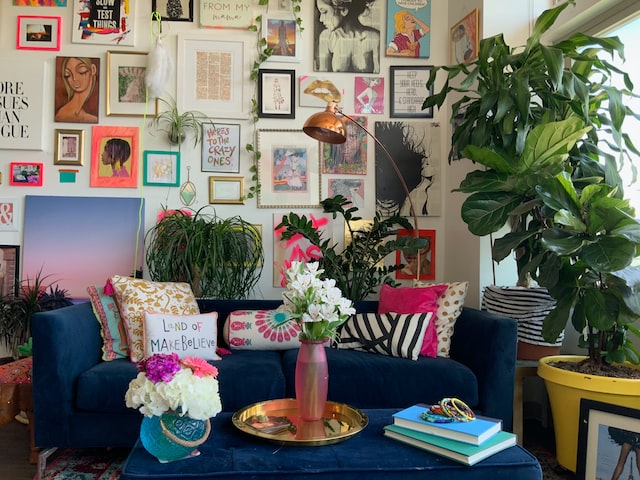
ponytail palm behind the couch on the left, image via Unspash @stephwilll
I recently discovered a plant that I hadn’t ever known before. It’s called the ponytail palm. However, it’s not actually a palm tree / plant at all. Instead, it’s a succulent. And yet it looks just like a tiny little palm tree. It’s adorable. I don’t know why I’ve never come across this plant before. Now that I know about it, I’m seeing it everywhere.
Discovering the Ponytail Palm Plant
Every month, my best friend and I try to get together at his place for what we call “wine and whine.” It’s just a friendship catch-up day of conversation and wine drinking. Recently, his apartment has been taken over by plants. It’s funny, because neither of us was ever really good with plants. We used to live together and I don’t think we ever had a living plant in our shared apartment. I once bought him and his husband a bonsai tree, and I don’t think it lasted a few months.
And yet, in recent months, my bestie has taken up indoor gardening. He’s loving it. He’s good at it!
So, as I’ve been going over there, his plant collection has grown. There were a few simple plants. Then there were some more complicated plants. He has plants that are on a weekly misting schedule. He waters other plants every few days. Over time, he has even repotted plants.
One of his most recent plant acquisitions, as you may have guessed, is the ponytail palm plant. He found it at a store while looking for new pots. He fell in love with it, he purchased it, and that’s how I discovered it, sitting in the corner of his home.
A Plant By Any Other Name …
My bestie actually introduced me to the plant as an elephant foot tree. You can see why when you look at it. After all, the trunk sure does look a lot like the foot of an elephant. However, I actually mis-remembered it as an elephant palm. It looks so much like a little palm tree. So, when I went to Google it and learn more about it, I typed in “elephant palm” and what came up was the ponytail palm tree.
According to the University of Arkansas Division of Agriculture, this plant’s official name is Nolina (Beaucarnea) recurvata. We most commonly know it as the ponytail palm. However, you might also refer to it as a bottle palm. And, like I said before, people sometimes call it the elephant foot tree.
A Palm, A Tree, A Succulent?
The ponytail palm looks like a palm tree. And yet, it’s not. Old Farmer’s Almanac explains that it’s more closely related to a Joshua Tree or a Yucca Tree. No wonder I’m drawn to this plant. I grew up in the Arizona desert. Therefore, I’m very familiar with these types of plants. I wouldn’t immediately think of the Joshua Tree when looking at the ponytail palm. Nevertheless, I see the family resemblance.
And, did you know, that the Joshua Tree isn’t a tree at all? It’s part of the agave family. And this, in turn, is a type of succulent. I’ve always loved succulents. That’s probably also the desert in me. So, again, no surprise that I found myself drawn to this plant.
How Big Is a Ponytail Palm Tree?
My friend’s new little plant is less than one foot tall. That’s partly why I like it so much. It’s this tiny, cute little palm tree in a pot inside of the apartment. However, as I did my research, I learned that these plants can actually grow to be quite huge. According to The Almanac, they can grow naturally in the wild to 30 feet in height with leaves that extend six feet long.
Of course, they don’t get that large when cultivated in a garden. Moreover, when grown indoors, they will remain quite small. They’re usually only about four feet tall when grown indoors. So, it will be interesting to see how tall my friend’s plant will get. We will get together once a month and I can watch his baby grow!
5 Tips for Caring For a Ponytail Palm Tree
Since this isn’t my plant, I don’t actually have to worry about caring for it. That’s my friend’s job. And yet, I was curious about what kind of care it needs. Between my friend’s information and what I found online, here are the five best tips I have for taking care of an elephant foot plant:
1. Lots of Light
This makes sense for succulents, of course. They want a lot of sunshine.
2. Fast-Drying Soil
Likewise, these aren’t plants that want to sit in water. They don’t want to be very wet. Use a fast-drying soil that’s good for cacti and succulents. Keep the soil relatively dry even when watering. The top soil should be completely dry before you water the plant again.
3. How to Water a Ponytail Palm
Basically, you want to soak the soil so that it gets wet all through it. However, you want to use a pot with draining holes. Moreover, you want to make sure that the excess water all drains out. You don’t want wet soil for this plant. This can’t be reiterated enough, according to the Internet.
4. Room Temperature
The plant likes to be kept in room temperature. However, make that room a little bit chillier in the winter months. Your plant will thank you. That said, don’t let the plant sit too close to windows with cold air. You want a plant that recognizes it’s a little cooler during winter, but you certainly don’t want to freeze your plant.
5. Repot Every Year or Two
In order to keep the plant small, all that you really need to do is keep taking care of it in its small pot. However, you’ll still need to repot it. Doing so once every year or two is ideal.
Are Elephant Foot Plants Trending?
I didn’t know about these plants until I saw my friend’s recently. And yet, now that I know about them, I keep spotting them everywhere. For example, I went to a little store on Haight Street that only had a few plants among many other things and there one was! Is this a case of noticing what you’re focused on? Or are these plants actually trending now?
Are you familiar with the ponytail palm tree? What do you call it?
Additional Links:
- 5 Quick Tips to Rescue Your Plant from Root Rot
- The Christmas Cactus Plant
- 5 Things to Consider When Recycling Soil

Kathryn Vercillo is a long time writer, crafter and author of several books. A resident of San Francisco, she is committed to helping others explore, articulate and share their own individuals stories. When she’s not evaluating investing opportunities Kathryn is an avid knitter, researcher, and blogger.
Leave a Reply