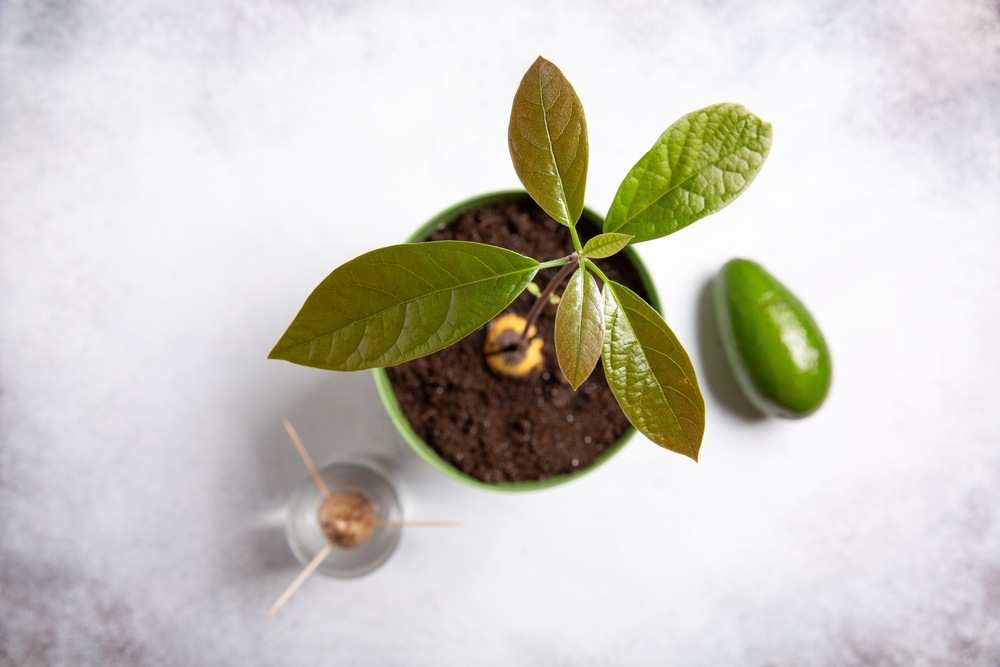
You finish an avocado, look at the enormous pit left on the cutting board, and wonder why you’d throw away something that appears perfectly capable of becoming another plant. The good news is that growing an avocado tree from a pit really does work, and you don’t need an expensive propagation kit to try it. The less exciting news is that the leafy little tree growing beside your window isn’t necessarily on its way to producing bowls of free guacamole. University of Florida IFAS says avocado trees grown from seed may take roughly four to 10 years to flower and fruit, while other guidance puts the wait at around seven to 10 years. Even after all that patience, the fruit—if you get any—probably won’t be identical to the avocado that supplied your pit.
Yes, That Avocado Pit Really Can Become a Tree
An avocado pit contains a viable seed, so the basic experiment you’ve probably seen online is legitimate. University of California Cooperative says avocado seeds can be suspended over water with toothpicks, keeping the broad end in water and placing the container in indirect light while refreshing the water at least weekly. You can also skip the glass entirely and germinate a cleaned seed in well-drained potting mix, which is closer to how avocado seedlings are propagated for eventual growing. Keep the seed warm and consistently moist rather than waterlogged, and don’t assume failure just because nothing happens during the first several days. Growing an avocado tree from a pit is inexpensive enough that the experiment costs little more than the avocado you were already planning to eat.
The Toothpick Method Isn’t Your Only Option
The glass-and-toothpick method became popular partly because watching roots emerge from a giant seed is genuinely fascinating. However, the University of Florida IFAS says the familiar water method isn’t necessarily the best approach if your real goal is eventually growing a tree. Planting a fresh, cleaned pit in a container with good drainage lets the seed begin developing where its roots can continue growing without the transition from water to soil. Different instructions vary slightly on planting orientation and depth, so following guidance appropriate to the propagation method you’re using is preferable to assuming every viral avocado hack is horticultural law. Whichever method you choose, think of the first few months as growing a houseplant rather than starting a guaranteed backyard fruit crop.
Your Grocery Store Hass Won’t Produce Another Hass
This is the catch that surprises many first-time avocado growers. University of California Agriculture and Natural Resources explains that avocados have considerable genetic variability, meaning a seed-grown tree isn’t genetically identical to its parent. Plant the pit from a delicious Hass avocado, therefore, and the resulting tree isn’t another Hass—it is a genetically different avocado with unpredictable characteristics. Its eventual fruit could be excellent, mediocre, poor, or the tree may never produce useful fruit at all. That’s why growing an avocado tree from a pit should be viewed as a fun gardening experiment rather than an inexpensive way to reproduce your favorite supermarket variety.
You Could Wait 10 Years to Discover What You’ve Grown
Fruit trees grown from seed must pass through a juvenile period before they’re mature enough to reproduce. UF/IFAS says seed-grown avocados can take four to 10 years to flower and fruit, while grafted avocado trees can begin producing in roughly three to four years. Another UF/IFAS tropical-fruit propagation resource estimates about seven to 10 years for seed-grown avocado trees because seedlings must progress through sexual maturity. That means a pit planted when your child enters kindergarten might still be keeping its fruit quality secret when that child reaches middle school. For a free plant experiment, that’s fascinating; for someone whose primary goal is harvesting avocados, it’s a very long gamble.
A Flowering Tree Still Doesn’t Guarantee Avocados
Reaching flowering age isn’t necessarily the final hurdle. Avocado flowers have unusual flowering behavior, with cultivars generally classified as type A or type B according to when flowers function as female and male. UC Cooperative notes that some avocados may require another variety for successful pollination and fruit set. Your mystery seedling’s genetics add another layer of uncertainty because you don’t know precisely what characteristics you’ve produced until the tree matures. Plenty of sunshine and proper care help, but no fertilizer can turn an unpredictable seedling into a genetically guaranteed Hass tree.
Climate May Be the Bigger Problem
Before imagining a 20-foot avocado tree beside the driveway, consider what winter looks like where you live. UF/IFAS explains that avocado cold tolerance varies substantially by type, with some tropical cultivars poorly suited to freezing temperatures while certain Mexican and Mexican-hybrid varieties tolerate considerably more cold. A grocery-store pit gives you less certainty about how the resulting seedling will perform in your particular climate than buying an identified cultivar selected for local conditions. In colder regions, growing an avocado tree from a pit usually makes more sense as a container or indoor plant that can be protected from freezing weather. Remember that avocado trees naturally become large, so the cute windowsill seedling may eventually need pruning, repotting, and considerably more room.
Grafted Trees Are the Better Bet for Fruit
If your goal is actually harvesting avocados, spending money on a grafted nursery tree generally offers much better odds than waiting on a kitchen experiment. Commercial avocado varieties are commonly propagated by grafting so growers know what fruiting variety they’re getting rather than rolling the genetic dice with seedlings. UC Cooperative explains that grafting joins material from a desirable fruiting variety to rootstock, allowing growers to preserve known fruit characteristics. UF/IFAS similarly recommends grafted avocado trees from reputable nurseries when desirable fruit is the goal. You can still grow your free pit, but don’t postpone buying a suitable grafted tree for a decade if producing fruit is the reason you started gardening.
Your Seedling Can Still Be Worth Growing
A plant doesn’t have to produce groceries to earn its place in your home. Avocado seedlings make attractive foliage plants, and watching the pit split, send down roots, and produce its first shoot is a particularly satisfying project for kids or beginning gardeners. You’re also turning something headed for the trash or compost into a living plant for essentially no additional cost. If you eventually have the climate, space, and skills, a healthy seedling can even serve as rootstock for grafting a known avocado variety, although successful grafting takes practice. From a frugal-gardening perspective, growing an avocado tree from a pit is a win as long as your expectations don’t require a basket of free Hass avocados.
Grow the Pit for Fun, Not Guaranteed Guacamole
So, can an avocado pit become a tree? Absolutely—and with warmth, moisture, drainage, and patience, it’s an inexpensive experiment worth trying. Can that same tree eventually produce fruit? Possibly, but you’ll probably wait years to find out, and its genetics mean the avocados won’t necessarily resemble the one you originally ate. If reliable fruit production matters, a locally appropriate grafted cultivar from a reputable nursery is the more predictable investment. If you’d simply enjoy turning kitchen scraps into a surprisingly impressive plant, however, growing an avocado tree from a pit is hard to beat for the price.
Have you ever grown an avocado pit long enough to turn it into a real tree—and did yours ever produce fruit?
What to Read Next
Indoor Avocado Plant Care Made Easy: Tips for Thriving Avocado Trees at Home
8 Kitchen Scraps That Actually Belong in the Compost — And 5 That Don’t
Can You Really Grow Free Plants From Grocery Store Produce? Here’s What’s Worth Trying
Leave a Reply